
Author: Liao Chuxin, Chief Pharmacist, Pharmacy Department, Zhongshan People’s Hospital
Editor: Fu Yongjin, Chief Pharmacist, Guangzhou Red Cross Hospital Affiliated to Jinan University

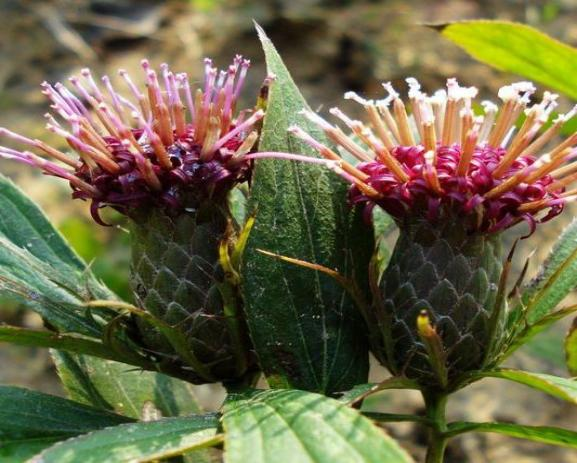
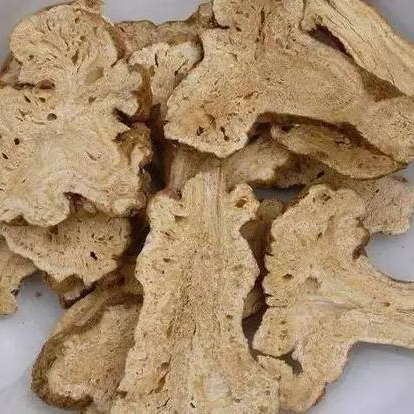 This product is the dried rhizome of the Asteraceae plant Bai Zhu (Atractylodes macrocephala). It is mainly produced in Zhejiang and Anhui provinces. It is harvested in winter when the lower leaves turn yellow and the upper leaves become brittle, then cleaned of soil, dried, and the fibrous roots are removed. It is cut into thick slices. The best quality has a yellowish-white cut surface and a strong aroma.
 Characteristics: Bai Zhu root is an irregularly shaped, thickened mass, measuring 3 to 13 cm in length and 1.5 to 7 cm in diameter. The surface is grayish-yellow or grayish-brown, with tuberous protrusions and intermittent longitudinal wrinkles and grooves, along with traces of fibrous roots. The top has remnants of the stem base and bud scars. It is hard and not easily broken, with an uneven cross-section that is yellowish-white to light brown, with scattered brownish-yellow oil chambers; the dried cross-section is horn-like, darker in color or with cracks. It has a clear fragrance, a sweet and slightly pungent taste, and is slightly sticky when chewed. The best quality is large, firm, with a yellowish-white cross-section, strong aroma, and sweet taste with little spiciness.
1
[Properties and Channels]
PSMChina
Bitter, sweet, warm. Enters the Spleen and Stomach channels.
2
[Functions and Indications]
PSMChina
Strengthens the Spleen and tonifies Qi, dries dampness and promotes urination, stops sweating, and stabilizes the fetus. Used for Spleen deficiency with poor appetite, abdominal distension and diarrhea, phlegm-dampness causing dizziness, edema, spontaneous sweating, and restlessness of the fetus.
3
[Dosage]
PSMChina
6 to 12 g
4
[Effect Analysis]
PSMChina
Bai Zhu is sweet, warm, and drying, adept at tonifying Spleen Qi and drying dampness, aligning with the Spleen’s preference for dryness and aversion to dampness. It has been praised by predecessors as the “most important medicine for the Spleen.” It can be used for various conditions such as Spleen Qi deficiency, middle Qi sinking, Spleen not controlling blood, Spleen Yang deficiency, Spleen deficiency with edema, and Spleen deficiency with phlegm-dampness. Bai Zhu excels in strengthening the Spleen and drying dampness, making it particularly suitable for treating Spleen deficiency with edema and phlegm-dampness. Bai Zhu can both tonify Qi and strengthen the Spleen, as well as stabilize the exterior and stop sweating, making it a commonly used herb for spontaneous sweating due to exterior deficiency; it is effective when used alone. Bai Zhu can strengthen the Spleen and tonify Qi, which nourishes the fetus, and since Bai Zhu has a calming effect on the fetus, it is suitable for pregnant women with Spleen deficiency and weak Qi, leading to insufficient nourishment and restlessness of the fetus.
5
[Compatibility Applications]
PSMChina
1. Bai Zhu with Fu Ling
Bai Zhu excels at strengthening the Spleen and drying dampness. Fu Ling is good at draining dampness and benefiting the Spleen. When these two herbs are combined, one dries dampness while the other drains it, thus improving Spleen Qi and promoting the movement of dampness. This combination is suitable for Spleen deficiency with excessive dampness, characterized by fatigue in the limbs, abdominal distension, poor appetite, diarrhea, edema, and difficulty urinating, as well as Spleen deficiency with leukorrhea.
2. Bai Zhu with Cang Zhu
Bai Zhu is more focused on tonifying and has a strong ability to strengthen the Spleen and dry dampness; Cang Zhu is more focused on drying and has a strong ability to dry dampness and strengthen the Spleen. The combination of these two herbs can enhance the effects of strengthening the Spleen and drying dampness, suitable for Spleen deficiency with excessive dampness.
3. Bai Zhu with Ban Xia
Bai Zhu is effective in tonifying Qi, strengthening the Spleen, and drying dampness, while Ban Xia is effective in drying dampness, transforming phlegm, and stopping vomiting. The combination of these two herbs can enhance the effects of strengthening the Spleen, drying dampness, and transforming phlegm, suitable for dizziness and headaches caused by phlegm due to Spleen deficiency, as well as chest tightness and vomiting.
4. Bai Zhu with Huang Qi
Bai Zhu excels at benefiting Qi and strengthening the Spleen, while Huang Qi is good at stabilizing the exterior and stopping sweating. The combination of these two herbs can enhance Qi and stabilize the exterior, preventing sweating, suitable for spontaneous sweating due to exterior deficiency or those prone to colds due to deficiency.
6
[Identification Applications]
PSMChina
1. Raw Bai Zhu, Stir-fried Bai Zhu, and Charred Bai Zhu The main processed forms of Bai Zhu include raw Bai Zhu, stir-fried Bai Zhu, and charred Bai Zhu. Raw Bai Zhu primarily focuses on drying dampness, strengthening the Spleen, and promoting urination to reduce swelling, used for phlegm-dampness, edema, and rheumatic pain. Stir-fried Bai Zhu has a stronger ability to tonify the Spleen and stop diarrhea, used for Spleen deficiency with poor appetite and diarrhea. Charred Bai Zhu can moderate its drying nature and enhance its ability to strengthen the Spleen, used for Spleen and Stomach disharmony, impaired digestion, poor appetite, fatigue, spontaneous sweating due to exterior deficiency, and restlessness of the fetus.
2. Bai Zhu and Cang Zhu Both have the ability to dry dampness and strengthen the Spleen, used for treating Spleen deficiency with water retention and damp stagnation in the middle burner, but Bai Zhu primarily strengthens the Spleen while Cang Zhu primarily dries dampness. Additionally, Bai Zhu can stop sweating and calm the fetus, treating spontaneous sweating due to Spleen deficiency and restlessness of the fetus; Cang Zhu can induce sweating, release the exterior, dispel wind, and treat external wind-cold with dampness and rheumatic pain. Furthermore, Cang Zhu can improve vision and treat night blindness and blurred vision.
7
[Chemical Components]
PSMChina
Bai Zhu mainly contains volatile oils, terpenes, flavonoids, polysaccharides, amino acids, and trace elements. The volatile oils and polysaccharides of Bai Zhu are its main pharmacologically active components.
8
[Precautions]
PSMChina
Use with caution in cases of Yin deficiency with internal heat or fluid deficiency causing dryness and thirst; avoid use in cases of Qi stagnation and distension.
9
[Summary of Materia Medica]
PSMChina
1. “Medical Origins” states: “Eliminates dampness and benefits the Spleen, harmonizes the middle and benefits Qi. Its uses are nine: warming the middle; eliminating dampness from the Spleen and Stomach; clearing Stomach heat; strengthening the Spleen and Stomach, promoting appetite; harmonizing the Stomach and generating fluids; treating muscle heat; alleviating fatigue in the limbs, causing lethargy and lack of appetite; stopping thirst; and stabilizing the fetus.”
2. “Supplement to Materia Medica” states: “The ability to eliminate dampness is superior. It can stop sweating if there is sweating, and induce sweating if there is none.”

[Examples of Medicinal Formulations]
medicine
1. Jianpi Wan (Clinical Medication Guidelines for Chinese Herbal Formulations, 2015 Edition)
Ingredients: Dang Shen (Codonopsis pilosula), Stir-fried Bai Zhu, Chen Pi (Citrus reticulata), Zhi Shi (Bitter Orange, stir-fried), Stir-fried Shan Zha (Hawthorn), Stir-fried Mai Ya (Barley).
Functions and Indications: Strengthens the Spleen and opens the appetite. Suitable for Spleen and Stomach weakness, abdominal distension and pain, poor appetite, and loose stools.
2. Xiang Sha Zhi Zhu Wan (Clinical Medication Guidelines for Chinese Herbal Formulations, 2015 Edition)
Ingredients: Bai Zhu (Stir-fried), Mu Xiang (Saussurea), Sha Ren (Amomum), Stir-fried Zhi Shi.
Functions and Indications: Strengthens the Spleen and opens the appetite, promotes Qi and resolves fullness. Suitable for Spleen deficiency with Qi stagnation, abdominal fullness and discomfort, poor appetite, and soft stools.
-END-
Some images in this article are sourced from the internet for public welfare dissemination. Thanks to the authors of the images; if there is any infringement, please contact us for removal.
This article is an original work by “PSM Yao Dun Public Welfare”. For reprints, please leave a message.
Review Expert: Liu Ruifeng, Chief Pharmacist, Pharmacy Department, Zhongshan People’s Hospital
References
[1] “Pharmacopoeia of the People’s Republic of China, Clinical Medication Guidelines, 2015 Edition, Chinese Herbal Pieces Volume”
[2] “Chinese Clinical Drug Dictionary, Chinese Herbal Pieces Volume”


Search for articles related to Bai Zhu